

Upstream Semiconductor Radar Companies
Calterah’s Lancang-USRR Radar Chip: Elevating Passenger Safety with 6T6R Architecture
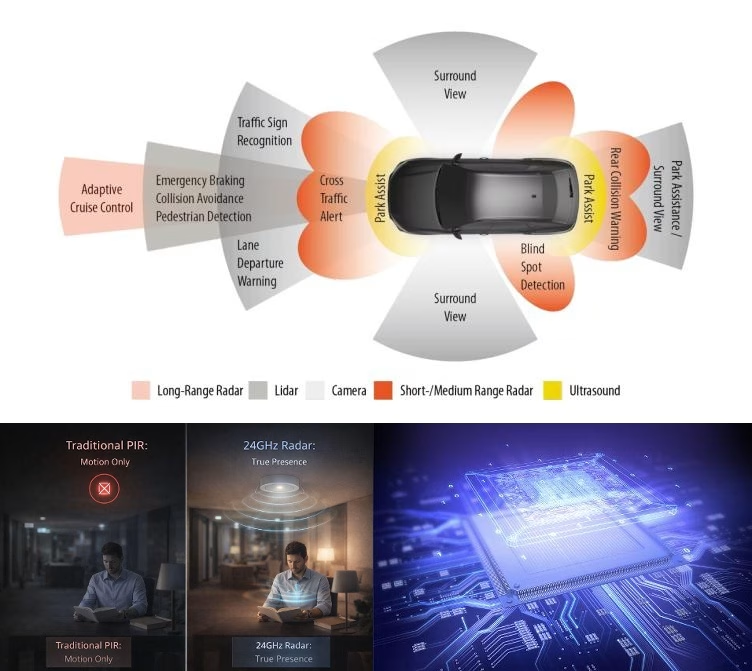
Calterah’s Lancang-USRR Radar Chip: Enhancing Passenger Safety with Innovative Technology
Key Highlights:
- Industry-first 6T6R architecture: Provides advanced precision and functionality in detecting vital signs, including heartbeat and breathing patterns.
- Exceptional obstacle penetration: Capable of detecting through thick blankets or fur.
- Functionality in poor visibility: Operates seamlessly in total darkness, addressing scenarios where cameras fail.
- Camera-free design: Ensures complete passenger privacy while maintaining reliable safety.
Insights:
Calterah’s Lancang-USRR radar chip addresses critical challenges in passenger safety by combining precise sensing capabilities, privacy protection, and adaptability to diverse conditions, such as low visibility or concealed environments.
source: [1]
company website: https://www.calterah.com/
🔒 Unlock 4 more Upstream Radar insights—Start your 14-day free trial
Greater China Mid-downstream radar companies
Nanoradar Introduces RVSM Platform for Seamless Integration with Video Management Systems

Nanoradar RVSM Platform Enhances Video Management Systems
Key Highlights:
– Seamless Integration: RVSM integrates millimeter-wave radar and video systems into existing VMS platforms like Milestone and Avigilon with no replacement required.
– Active Monitoring: Enables 24/7 active detection, accurately locating targets by distance, angle, and speed, while triggering alarms and video feeds automatically.
– AI-Driven Target Filtering: Classifies multiple targets (e.g., humans, vehicles, animals) and filters environmental disruptions (e.g., rain, snow), reducing false alarms and improving response efficiency.
– GIS Integration: Allows visual security zone mapping using tools like Google/Baidu maps for intuitive defense planning.
– Closed-Loop Operation: Security personnel handle alarms, confirm video, and document incidents entirely within the original VMS interface without switching systems.
Insights:
The RVSM platform enhances existing security systems with intelligent radar-video fusion, making monitoring proactive and intuitive.
source: [1]
company website: http://www.nanoradar.cn/
🔒 Unlock the rest of Greater China Radar insights—Start your 14-day free trial
APAC Mid-downstream radar companies
Bitsensing’s 4D Radar Technology Driving Autonomous Vehicles and Smarter Cities
Bitsensing’s 4D Radar Technology Driving Autonomous Vehicles and Smarter Cities
Key Highlights:
- 4D Radar Capabilities: Combines distance, velocity, position, and vertical resolution, enabling detection of object shape, speed, and elevation. Crucial for reliably navigating fog, rain, darkness, and snow.
- Autonomous Applications: Foundational for robotaxis, Advanced Driver Assistance Systems (ADAS), commercial fleets, and smart city traffic sensing.
- Market Expansion: Automotive radar market projected to grow from $5.32B in 2023 to $22.83B by 2032, driven by ADAS adoption and evolving safety regulations.
- Integration in Smart Cities: Radar sensors paired with AI algorithms are helping urban planners manage traffic flow, reduce congestion, and improve air quality, as seen in Porta Nuova, Verona.
- Advantages Over Other Sensors: Performs effectively in all weather and lighting conditions; integrates seamlessly with vision systems for enhanced safety, such as Automatic Emergency Braking (AEB) and Smart Cruise Control.
- Commercial Fleet Adoption: Korea has begun deploying radar-based ADAS kits in commercial buses, with plans to improve fleet safety and accuracy in detecting vehicles and pedestrians.
Insights:
Bitsensing’s integration of 4D imaging radar into autonomous systems and smart cities emphasizes radar’s essential role in creating a safer, smarter, and more sustainable future for transportation.
source: [1]
company website: https://bitsensing.com/
🔒 Unlock the rest of APAC Radar insights—Start your 14-day free trial
US Mid-downstream radar companies
Radar vs. LiDAR: How Ainstein’s Radar Solutions Provide Robust Perception Under Adverse Conditions
Radar vs. LiDAR: Ainstein’s Radar Insights Under Adverse Conditions
Key Highlights:
– Environmental Reliability: Radar’s millimeter-wave technology maintains performance in challenging conditions like rain, fog, and dust, while LiDAR struggles with scattering from airborne particles.
– Cost and Application: Radar systems are more affordable and can provide real-time velocity data and robust environmental awareness, particularly in adverse weather.
– Operational Cases:
– UAVs: Radar altimeters (e.g., Ainstein’s LR-D1 Pro) ensure safe low-altitude operation under visibility challenges.
– Agriculture: Sensors like K-77 and I-79 deliver consistent detection and velocity tracking in dust-heavy environments.
– Industrial Sites: Radar (e.g., O-79) assists in safety for heavy machinery by maintaining operation where optical sensors require frequent maintenance.
– Urban Autonomy: For last-mile delivery, radar excels in collision prevention where visibility and lighting conditions vary.
– Complementary Roles: While LiDAR provides greater spatial resolution for scene mapping, radar ensures reliability and uptime, making it essential in diverse operational applications.
Radar serves as a critical backbone sensor in autonomy systems, ensuring dependable performance in environments unsuitable for optical technologies.
source: [1]
company website: https://ainstein.ai/
🔒 Unlock the rest of US Radar insights—Start your 14-day free trial
EMEA Mid-downstream radar companies
Forvia Hella and NXP Collaborate on High-Resolution Radar for SAE Level 2+ and Level 3 Intelligent Driving
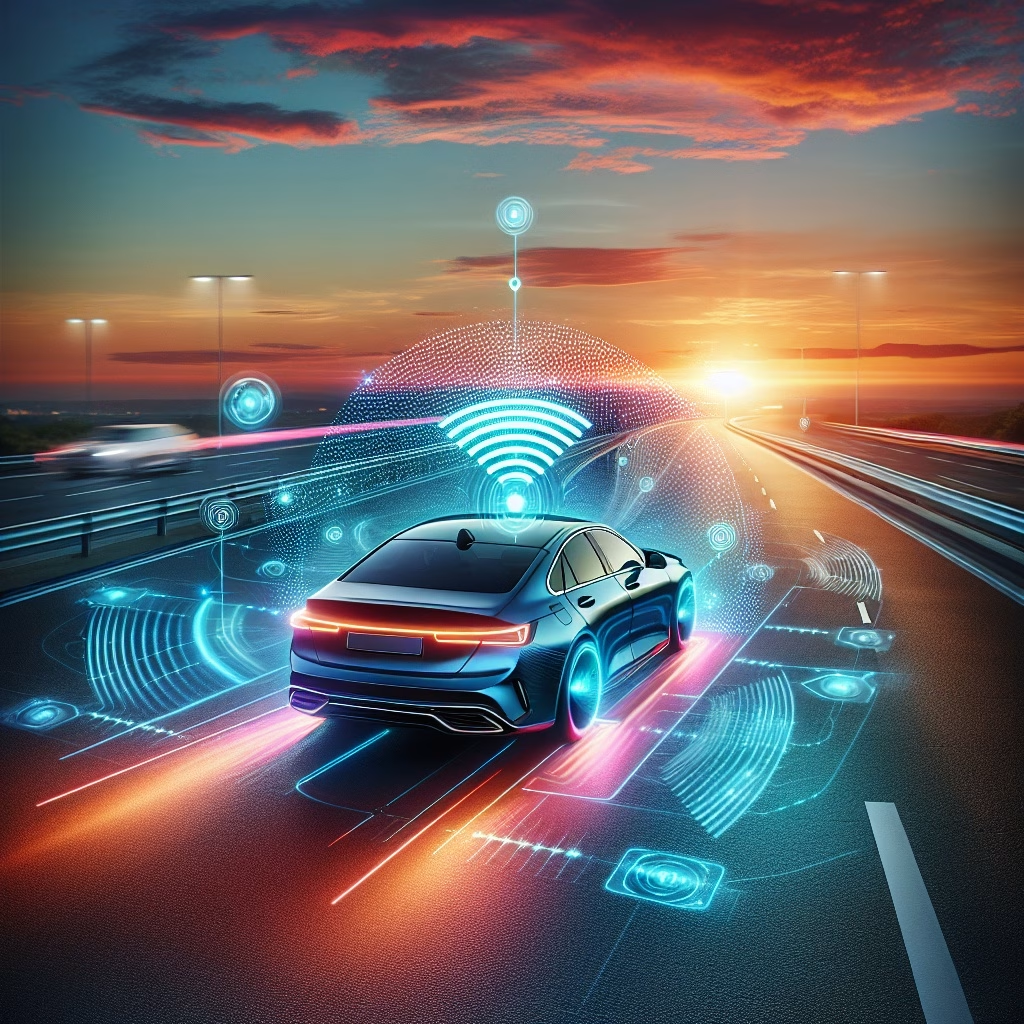
Forvia Hella and NXP Partner on High-Resolution Radar for SAE Level 2+ and Level 3 Driving
Key Highlights:
– Radar Sensor Specifications: The ForWave7HD incorporates up to 32 transmission and reception channels, enabling wide coverage, detection of small objects, and a range of up to 400 meters.
– Intelligent Driving Integration: Designed for SAE Level 2+ and Level 3 systems, ensuring enhanced automation, safety, and reliable performance.
– Production Plans: High-resolution radar sensors are set for mass production by mid-2028, targeting major global premium manufacturers, with projected orders surpassing hundreds of millions of euros.
– NXP’s Contribution: NXP supports the radar with high-frequency signal transmission and echo reception chips to precisely determine object locations, speeds, and distances.
– Forvia Hella Expertise: With 25 years of radar development experience, Forvia Hella leads product development, fusing advanced antenna technology with semiconductor solutions.
Industry Impact:
This collaboration aims to shape future intelligent driving systems by accelerating development and setting benchmarks in long-range detection and safety automation.
source: [1]
company website: https://www.hella.com/
🔒 Unlock 4 more EMEA Radar insights—Start your 14-day free trial
Upstream Semiconductor Radar Companies
Greater China Mid-downstream radar companies
APAC Mid-downstream radar companies
US Mid-downstream radar companies
EMEA Mid-downstream radar companies